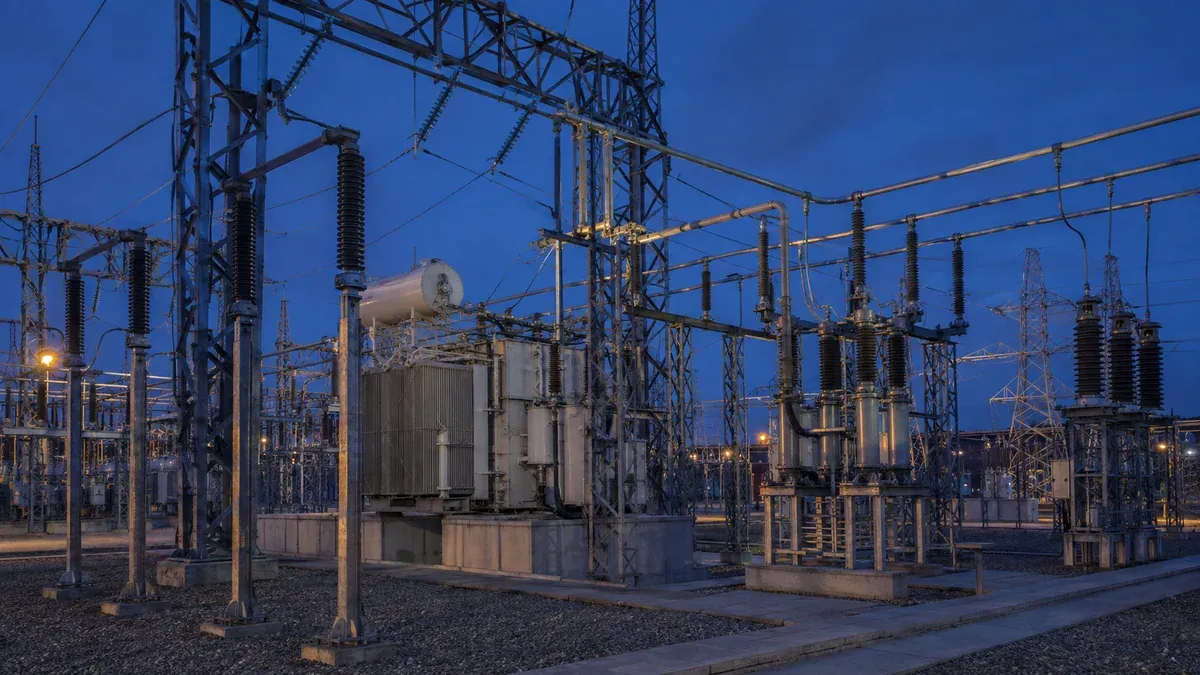
An artificial intelligence data center can buy enough electricity on the contract, but it still cannot start on schedule. Power generation companies can promise to provide electricity, but the power grid may not already have the transmission lines to deliver this electricity to the park; the park can build a computer room, but the substation and main transformer may still be delivered; technology companies can purchase renewable energy certificates, but during periods when there is no wind or light, the servers still need to run continuously. For computing power, electricity is never a single purchase item on financial statements, but a set of physical conditions that must be realized together at a specific place and at a specific time.
Chips convert electrical energy into computation, which ultimately leaves the cabinet as heat. This process may seem straightforward, but behind the scenes it involves at least power generation, transmission, distribution, transformation, backup power, cooling and real-time dispatch. If any link is late, the servers that have been delivered may become capital that cannot be fully utilized. Therefore, when the training and inference of large models begin to form industrial loads, the question is no longer just "how many kilowatt hours of electricity are needed", but "who can guarantee that this electricity will arrive when needed".
The International Energy Agency estimates that global data center electricity consumption will be approximately 415 terawatt hours in 2024, accounting for approximately 1.5% of global electricity consumption; the United States, China, and Europe together account for the majority. In its baseline scenario, the agency projects that global data center electricity consumption could increase to about 945 terawatt hours by 2030.[1] These figures illustrate the scale of demand but do not directly answer the question of power supply. The same one terawatt-hour of electricity will have completely different delivery results depending on what kind of power source it comes from, when it is generated, and whether it can be delivered to the load center across congested grid nodes.
So the question of "who's powering the model?" doesn't come with a single company name. Generators produce electricity, grid companies provide transmission channels, system operators maintain frequency and supply-demand balance, local governments determine land and permitting, data center developers build power transformation and cooling facilities, and technology companies lock in resources through long-term contracts, capital investments, and load dispatching. What the model really relies on is whether these agents can complete their respective tasks on the same schedule.
Buying electricity does not mean gaining capacity
To understand data center power supply, we must first distinguish between power and capacity. Electricity describes how much electricity is consumed within a period of time, and is commonly measured in kilowatt hours, megawatt hours, or terawatt hours; capacity describes how much power can be provided at a certain time, and is commonly measured in megawatts or gigawatts. The electricity purchased by a park throughout the year may be enough to cover the book demand, but if the node cannot stably provide hundreds of megawatts of capacity during peak summer hours, the computer room will still not be able to operate at the designed scale.
This difference also explains why large data centers first ask about "deliverable capacity" and "earliest power delivery time" when selecting sites, rather than just comparing electricity prices. Servers can be installed in batches, but the power infrastructure must leave room for peak loads, redundancy and subsequent expansion. Even if only a few cabinets are initially deployed on the campus, the grid will need to evaluate whether its eventual size will exceed the carrying capacity of existing lines, substations, and regional power supplies.
Artificial intelligence load is more difficult to summarize by average than traditional office load. Training tasks can maintain high utilization for a period of time, and may also fluctuate due to checkpoint saving, failure recovery, or task switching; online inference changes with user requests and places higher requirements on latency and availability. Data centers also bear additional energy consumption for cooling, networking, storage and power conversion. The nominal power consumption of the chip is only the starting point. What the power grid faces is the load curve of the entire campus on different time scales.
Long-term power purchase agreements can provide revenue expectations for new wind power or photovoltaic projects and can also help companies lock in some energy costs, but they do not automatically solve the hour-by-hour supply and demand matching. The renewable electricity generated in a certain area during the day can be used to offset the data center power consumption in another area at night in annual accounting; from the perspective of the power system, the nighttime load still needs to be met by power sources, energy storage or cross-regional power transmission that can output power at that time. "How much green electricity is used in the year" and "what power source supports the operation" every hour are two related but not interchangeable questions.
Electricity supply is a chain of joint delivery
From the power plant to the model, there is no single wire that belongs to technology companies. Power generation companies are responsible for building and operating power sources, transmission networks deliver large-scale power to load areas, distribution or regional power grids complete the final connection, and system operating agencies continue to balance power generation and power consumption. Data center developers will need to build dedicated substations, uninterruptible power supplies, backup power generation equipment and cooling systems, and reduce the risk of single points of failure through multiple power supplies. Neither party can complete this deal alone.
Technology companies are entering the energy system through longer-term contracts, but the focus of the contract resolution is not the same. The power purchase agreement mainly solves the problem of electricity, price and project financing; the capacity contract solves the callable capacity; the renewable energy certificate solves the accounting of environmental attributes; direct investment in power supply or substation facilities transfers part of the construction risk to the data center side. Calling these arrangements collectively “buying electricity” masks differences in delivery times, reliability and risk exposure.
For continuously operating clusters, controllable power remains valuable. Hydropower, nuclear power, gas-fired power generation, energy storage and inter-regional transmission may all assume stable capacity, but each is subject to hydrological conditions, construction cycles, fuel prices, carbon emissions and safety regulations. Renewable energy can provide low-carbon electricity, energy storage can shift part of the time, and demand response can cut short-term peaks, but no one technology can solve all problems at the same cost in all regions. The power supply structure ultimately depends on the local existing power grid, resource endowment and how quickly new projects can be put into operation.
The power system inside the computer room also forms part of the power supply chain. When the power grid is disturbed, uninterruptible power supplies are needed to maintain equipment operation, and backup generators are required to handle fault transitions for a long time; high-density cabinets require liquid cooling, cooling towers or other thermal management facilities to be in place simultaneously. Improving supply reliability often means more redundancy, which also means higher capital expenditures and some spare capacity. The so-called "powering the model" actually includes a complete set of insurance prepared for breakdown, maintenance and extreme weather.
What is truly scarce is often access time
Generation resources are not necessarily located near computing needs. Even if there is sufficient power in the area, new loads may still be stuck in transmission sections, substation capacity or equipment delivery schedules. The International Energy Agency notes that in advanced economies, it typically takes four to eight years to build new transmission lines.[1] In contrast, server procurement and computer room construction can be advanced in a shorter period. The speed difference between digital equipment and electric power projects makes "when can electricity be connected" gradually become a more important site selection condition than land price.
U.S. data illustrate this pressure most vividly. Citing research from Lawrence Berkeley National Laboratory, the U.S. Department of Energy pointed out that data center electricity consumption will increase from 58 terawatt hours in 2014 to 176 terawatt hours in 2023, accounting for approximately 4.4% of national electricity consumption; by 2028, related electricity consumption may reach 325 to 580 terawatt hours, accounting for 6.7% to 12%.[2] The wide forecast range illustrates that growth depends on equipment efficiency, project delivery rates and whether the grid can be expanded on time.
If the power grid is built in advance for each project according to the maximum scale submitted by the developer, it may end up being an asset that no one uses; if it is only expanded after the load is determined, it may make the real project wait for many years. Repeated occupations, project cancellations and scale adjustments in grid connection applications make it difficult for planners to judge demand. Solving this problem is not just about speeding up approvals, but also requires stricter access deposits, phased power delivery plans, shared power substation facilities, and more credible commitments from data centers to the actual start-up time.
China offers different organizational approaches to the same issue. "Eastern Data and Western Calculation" first deals with the spatial mismatch between computing power requirements, energy, and land: guiding some tasks suitable for long-distance processing to areas with more suitable energy and climate conditions. With the rapid growth of artificial intelligence loads, policy and industry discussions have further turned to "computing and power coordination". The focus is no longer just on where to place servers, but on allowing computing tasks, green power output, grid carrying capacity, energy storage and electricity price signals to participate in scheduling.[3]
The significance of computing-power collaboration lies in treating part of the computing load as an adjustable resource. Training, offline inference, data preprocessing and backup tasks that are not sensitive to delays can be migrated between different campuses or different time periods to take advantage of renewable energy-rich periods and lower electricity prices; user-oriented real-time inference, financial transactions and industrial control are more difficult to move away from demand centers. Only by distinguishing workloads first can computing power scheduling truly participate in power balancing, rather than simply moving all tasks from the east to the west.
For real implementation, it is necessary to get through three sets of information that were originally separated from each other. The computing platform must know the time limit, data location, and interruptibility of the task. The power system must provide time-of-use electricity prices, green power output, and grid congestion signals. The campus must continuously report available servers, cooling margins, and spare capacity. Only by seeing these constraints simultaneously can the scheduling system decide whether a training should run immediately, be delayed for several hours, or be moved to another node. Computing and power coordination is therefore not just a slogan for energy procurement, but also the data interface and responsibility boundary between computing and power dispatching.
The changes in Japan illustrate that even a mature economy with long-term slow growth in electricity consumption will re-evaluate power planning due to data centers. Long-term forecasts from Japan's Wide Area Transmission Operator show data centers and semiconductor factories are pushing national power demand to end a multi-year decline and return to growth.[4] For areas with intensive demand such as Tokyo and Osaka, the problem includes both new power sources and investment in power transformation, transmission and distribution around the city. There is no American model or Chinese model that can be copied here. The power supply solution must be embedded in the existing regional power grid and energy structure.
The three scenarios point to the same fact: power constraints are never abstract national total shortages, but mismatches at specific nodes, specific periods, and specific construction cycles. The United States is facing a rapid and concentrated application for grid connection, China is trying to expand the spatial and temporal adjustment range of load through computing and power coordination, and Japan needs to redo investment arrangements in a mature power grid for new growth expectations. Systems vary between countries, but all require realignment of computing project schedules with power system schedules.
Who bears the cost of grid expansion?
When a data center requires new transmission lines, substations, and generation capacity, the most sensitive issue is often not technology but cost allocation. If the project fully bears the cost of dedicated facilities, it can reduce the risk of ordinary users subsidizing large loads, but it may shift the location to areas with lower charges; if the power grid incorporates new investments into public rates, the park can obtain infrastructure faster, but residents and other businesses may share a long-term asset that mainly serves a small number of customers.
Proper scheduling often requires distinguishing between dedicated assets and system assets. Access lines and substation equipment that only serve a single campus should be borne more by the project; upgrades to the backbone network that can improve regional reliability and alleviate existing congestion may be shared by a wider range of users. The difficulty is that both often happen at the same time: a new line triggered by a data center may also improve the power supply to other loads. Regulators must determine whether the assets are still useful after project cancellation and set up corresponding guarantees to avoid leaving development risks to grid users.
Local governments also face the balance between benefits and costs. Data centers can bring investment, tax revenue and infrastructure upgrades, but direct employment after operation is usually less than that of a manufacturing project of the same size; it also takes up land, power capacity and certain water resources. In regions with tight power supplies, allocating capacity to data centers could squeeze out new demand for housing, manufacturing or the electrification of transportation. Therefore, the investment commitment should not only calculate the project investment amount, but also calculate the long-term public benefits brought by each megawatt load.
Nor can environmental costs be measured solely by annual renewable energy purchases. A park may purchase the same amount of green electricity throughout the year, but use a large amount of electricity during high-carbon periods on the grid; it may also actually reduce marginal fossil energy output by shifting tasks to periods when renewable energy is abundant. The former improves new clean energy financing, and the latter improves real-time system operations. A more mature disclosure would present annual electricity generation, hour-by-hour matching, marginal emissions on the grid, and cooling water consumption simultaneously, rather than summarizing the full impact in a single percentage.
Cooling further links power issues to climate and water resources. On the one hand, high temperature weather increases the electricity consumption for cooling, and on the other hand, it may also increase the air-conditioning load of the entire power grid. Parks that rely on evaporative cooling can reduce part of the power consumption, but they need to stabilize the water source. Solutions to reduce water use may increase the power consumption of compressors and fans. A design that performs efficiently at average annual temperatures may not maintain the same performance during extreme heat and water shortages. Siting and operational decisions therefore require a simultaneous assessment of power, water, temperature and cooling conditions.
Efficiency reduces stress and may expand demand
Improvements in the efficiency of chips, models, and inference systems can directly reduce the power required to complete the same task. Lower precision calculations, sparse models, caching, batch processing, and higher device utilization can all reduce idle servers and ineffective operations. Improvements in cooling and power supply and distribution efficiency will also allow more of the electricity entering the campus to be used for computing instead of being consumed in auxiliary systems. For campuses that are already limited by access capacity, the efficiency is equivalent to releasing new available space.
However, after the unit computing cost decreases, more applications may be deployed and the frequency of calls may also increase. Efficiency reduces the power consumption of each inference, but does not guarantee that the total power consumption will decrease. The most important thing for grid planning is not to bet on a certain chip efficiency, but to build forecasts that can be updated with real loads: which projects have been financed, which equipment has been ordered, which capacity is only in the long term, and how software efficiency will change actual utilization.
A more valuable direction is to combine efficiency with flexibility. Some training tasks can reduce power or delay startup when the power grid is tight, and improve utilization when renewable energy is abundant; the cross-regional computing platform can migrate tasks that are not delay-sensitive to campuses with more suitable power supply conditions; energy storage and backup facilities can also participate in demand response when rules allow. Only when the data center changes from a simple rigid load to a manageable load can it change from a part of the grid pressure to a part of the balancing tool.
For flexibility to enter the electricity market, it must also be able to be metered. The grid needs to know how much power the campus would have originally used, how much it actually reduced when the signal was received, how long it lasted, and whether the task was simply shifted to a nearby time period to create a new peak. Data centers need to determine the true cost of interrupting training, delaying inference, or migrating data. Without unified baselines, telemetry and settlement rules, so-called flexible loads tend to stay in demonstration projects; only after a service that can perform is formed, can it replace part of the expensive peak capacity.
There are still boundaries to this transformation. Frequent power changes may affect training progress and equipment operation. Real-time inference cannot be paused when users need it. Cross-region migration is limited by network bandwidth, data compliance, and latency. Backup power should not reduce emergency capabilities due to the pursuit of revenue. Computing and electricity collaboration does not assume that computing can be moved at will, but identifies which loads are elastic and establishes a verifiable and billable scheduling mechanism for these elasticities.
By 2030, the gap will be in delivery capabilities
The International Energy Agency predicts that global data center electricity consumption could approach 945 terawatt hours by 2030, but that number is not a destined end point. Model requirements, hardware efficiency, construction speed and grid access can all change the results.[1] The more important change is that new loads will not be evenly distributed. Areas that can provide land, network, clean electricity and stable capacity quickly will absorb more projects; areas that lack transmission space or have too long construction cycles may lose deployment opportunities even if they have market demand.
The future power supply mix will not be dominated by any one energy source alone. Renewable energy will bear more and more of the new power generation, energy storage and cross-regional power transmission will improve time matching, nuclear power, hydropower or gas power generation will provide controllable capacity in different regions, and demand response and computing power dispatch will reduce peak pressure. What really determines the outcome is not which technology takes center stage in the propaganda, but whether these resources can be combined at the same node and within the same timetable.
It also means that technology companies’ energy capabilities will move from being a cost management function within procurement departments to becoming part of infrastructure strategies. Enterprises need to participate in power grid planning earlier, make credible commitments to project capacity, bear corresponding access costs, and allow software dispatch to expose the flexibility to participate in the power market. Grid companies need to understand how calculated loads actually operate, rather than treating all applications as the same maximum load throughout the year. The closer the information from both parties is to real operation, the more likely it is that the contradiction between over-construction and long-term waiting will be alleviated.
The ultimate competition is collaborative delivery capabilities
The answer ultimately isn’t any one option among wind, nuclear or gas, nor is it a single technology company or utility. Powering the model is a set of co-delivery systems: the power supply provides the power and capacity, the grid provides access and stability, the data center converts the power into usable computing, the software determines when and where the load occurs, and the regulatory system determines who bears the cost and risk.
When this system is disconnected from each other, the most advanced chips may be waiting to be connected to the grid, the cheapest green electricity may not be able to pass through congested lines, and the most ambitious investment plans may be stalled in capacity applications. When power, power grids, campuses, and task scheduling begin to work together, computing will have the opportunity to become a sustainably expanded industrial capability. The computing and computing synergy emphasized by China, the access reform being faced by the United States, and Japan's reassessment of long-term demand are essentially dealing with the same problem: how to make watts and bits grow according to the same timetable.
Model capabilities are still determined by algorithms, data, and calculations, but whether these capabilities reach users on time increasingly depends on a simpler condition: whether electricity can consistently arrive where it is needed. The leaders in the computing power landscape in the future will not only be those with more servers, but will also be the first to organize power generation, transmission, access, cooling and computing scheduling into complete delivery capabilities.